

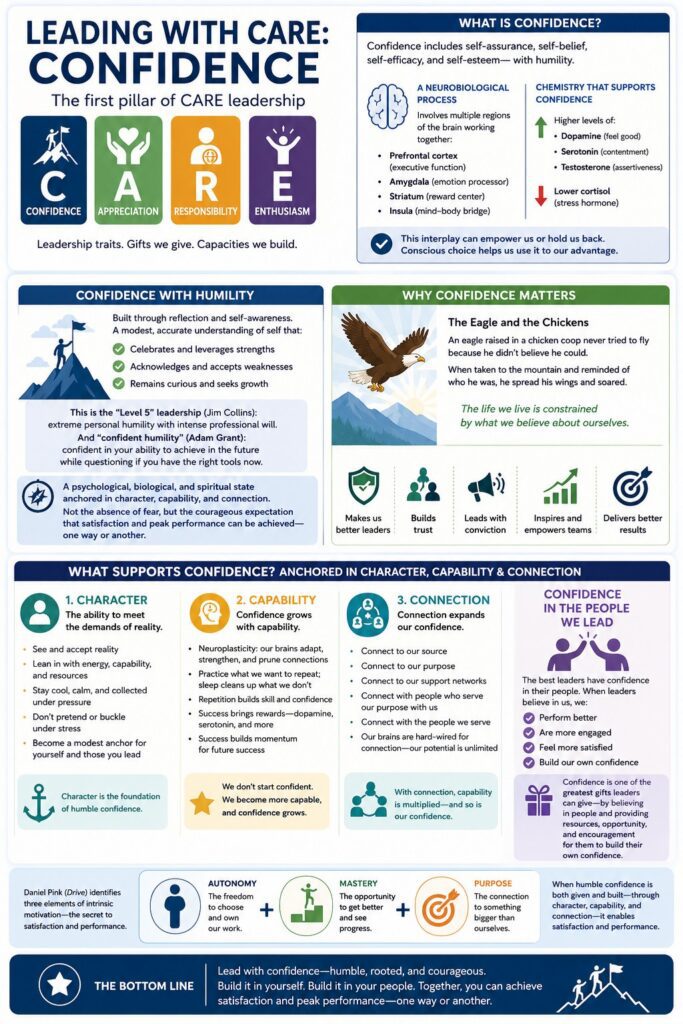
In my previous article I introduced the leadership mindset I’ve called CARE, which is leading with Confidence, Appreciation, Responsibility, and Enthusiasm. These are leadership traits as well as gifts leaders can give to and build within their teams. In this article I’ll dive a little deeper into the first pillar of this mindset: leading with confidence.
What is confidence?
Is it self-assurance, self-belief, self-efficacy, self-esteem? While psychologists often distinguish these, the idea of confidence that I use as the first pillar in the CARE leadership mindset encompasses all of these, with humility.
A neurobiological process
Confidence is more than just a psychological trait, however. It is also a neurobiological process involving multiple regions of the brain and neurotransmitters and hormones that regulate mood, motivation, and stress responses.[i] Higher levels of confidence correspond with higher levels of activity in our prefrontal cortex[ii][iii] (executive function) and our striatum[iii] (reward center). Our prefrontal cortex also interacts with our amygdala[ii] (our emotion processor) and insula[iii] (the primary bridge between our body and mind) both to inform our level of confidence and to regulate our associated physical and emotional responses. Higher levels of confidence also correspond with higher levels of dopamine[iv] (“feel good” neurotransmitter), serotonin[v] (which supports contentment and self-assurance), and testosterone[vi] (supporting self-assurance and assertiveness). Higher confidence also comes with reduced cortisol levels (the “stress hormone”) which supports improved emotional regulation.[vii] This neurobiological interplay in the brain and body can enable us to feel and act with more confidence, or it can hold us back. When we bring conscious choice into the equation, we have a much better chance of deploying this process to our advantage.
With humility
Confidence, in CARE leadership, comes with humility. Leading with confidence requires reflection and self-awareness. It grows from a modest and accurate understanding of self that celebrates and leverages strengths, that acknowledges and accepts weaknesses without judgment, and that is always curious and seeking opportunities to grow. This kind of modest confidence is included in what Jim Collins called Level 5 leadership. In Good to Great, he reported on the results of 5 years of extensive research into what made eleven companies go from good to great. In the 15 years from their transition point, these companies averaged cumulative stock returns 6.9 times the general market.[viii] In this study, he found that every good to great company had leaders at the helm during their transition era that blended “extreme personal humility with intense professional will.”[ix] I’m referring here also to the kind of confidence that Adam Grant describes, in Think Again. He calls it “confident humility,” which is confidence “in your ability to achieve a goal in the future while maintaining the humility to question whether you have the right tools in the present.”[x]
Anchored in character, capability, and connection
This humble confidence of CARE leadership is a psychological, biological, and spiritual state of being that is anchored in character, capability, and connection. It is not an expectation that nothing will ever go wrong. Nor does it mean the complete absence of fear. Rather, it is a courageous expectation that, one way or another, satisfaction and peak performance can always be achieved. Leaders can develop and nurture this confidence for themselves, and they can support and promote it in and for the individuals and groups of people they lead.
Why does confidence matter?
Confidence can make all the difference. In 1999, when I was going through a particularly difficult time, I came across a book by Alan Cohen called Dare to Be Yourself. In it, he wrote of a parable that had a profound impact in my life. It was about a solitary eagle that had been raised among chickens. That majestic bird, that could have been king of the skies, was living out his life in the confines of a chicken coop. While he was born to fly, he never learned and never tried. Even when the farmer tried to encourage him to fly, he would just fall to the ground. He simply didn’t believe in himself. Eventually, a visiting naturalist took the eagle to the top of a high mountain and lifted him up toward the sun proclaiming, “You are an eagle. You belong to the sky as well as the earth. Stretch forth your wings now and fly!” When the eagle finally did hesitantly stretch out his wings, and felt the wind beneath them, “with a triumphant cry he soared into the heavens.”[xi] The obvious lesson from that story is that the life we live is constrained by what we believe about ourselves. When I read that story, I began, in earnest, a new journey to find and release the eagle within me. I spread my wings, and I did fly.
We all have talents and strengths with which we can soar the heavens. As individuals, as we own, leverage, and develop our strengths, we can build the confidence that will enable us to live to our greatest potential. As leaders, we can also build confidence in our people that will enable them, and our teams, to achieve their highest potential as well.
Confidence matters because it makes us better leaders. It builds trust. We are more effective when we lead with conviction. We inspire our people and teams into their empowered future. We, and they, deliver better results.
What supports confidence?
Confidence is anchored in character, capability and connection.
Character
Dr. Henry Cloud defined character as “the ability to meet the demands of reality.” [xii] Character is the ability to see and accept reality for what it is and then to lean in with the energy, capability, and resources needed to address that reality. “Some people proactively wrap their arms around the situation, get energized, become clear headed, get to work, and have all their capacities available to them.”[xiii]
With character, we face reality without being overcome by stress and anxiety. The circuitry and the chemistry in our brains and bodies work in our favor to support us in remaining cool, calm, collected. We don’t pretend that reality is different from what it is. We don’t buckle under pressure. Instead, we become a modest anchor for ourselves and for those we lead.
When this is true for us, when we have lived it, and when we know it for ourselves, we have a solid foundation for confidence, for being the Level 5 leader that Jim Collins described, and for being a leader with Adam Grant’s “confident humility.”
Capability
Most of us do not begin new endeavors with the degree of confidence we hope for; rather, our confidence builds with our capability. Whether it’s general trust in our ability[xiv] or a specific spirit we carry into particular experiences,[xv] our confidence grows with our relevant capability.
Neuroplasticity is the well-studied and often-cited process by which the brain strengthens and prunes neural connections. Our brains are designed to adapt and learn. Practice may not actually make perfect, but with repetition, we reinforce synaptic connections that serve our purpose. Conversely, when we consciously practice only the patterns we want, the lesser-used synaptic connections are cleaned up when we sleep, making us less likely to follow those patterns again. We all experience this when we learn how to walk, how to ride a bike, how to play a musical instrument or a sport, how to drive a car, how to do our job, how to lead. When we get better at it, and we see more of the results we’re looking for, our brains reward us with neurotransmitters that support confidence and pleasure. Success builds momentum for future success.
Connection
Connection builds confidence. I used to rely too heavily on Étienne’s advice, “If you want something done right, do it yourself.”[xvi] Sure, if your objective is simply to achieve the outcome that you already believe you can deliver on your own, then that counsel might help. But I have found that it also fosters too much independence, at the expense of interdependence. When my confidence was constrained by my own capability, it was as limiting as the chicken coop for the eagle I mentioned earlier. I could not dream any bigger than I knew I could deliver.
With connections, capabilities available to us expand exponentially. When we are connected to our source, our confidence can be rooted in capability far greater than our own. When we remain connected to our purpose, we have the confidence of knowing we are doing what we were designed to do. When we connect the people in our support network, we have access to more capacity and capability. When we connect with the people we work with and the people we serve, we again can have the confidence of operating as we are designed.
In philosophy and psychology, from Aristotle[xvii] to Aronson,[xviii] we have known ourselves to be social animals. Modern neuroscience has also revealed that our brains are hard-wired for social connection.[xix] We have unlimited potential, and opportunity for confidence, when we remain connected to our source, to our purpose, to our support networks, to the people who serve our purpose with us, and to the people we serve.
Confidence in the people we lead
Leading with confidence is as much about the people being led as it is about the leader. The best leaders have confidence in themselves, yes, but they also demonstrate confidence in their people. I know this from personal experience. I always performed better when I knew that my leader had confidence in me. I was always more engaged. I was always more satisfied and more confident in myself. Leading with confidence is one of the greatest gifts that leaders can give to their people. They show confidence in them. They provide resources, opportunity, and encouragement for them to build their own confidence.
In his NY Times bestselling book on what he called Motivation 3.0, Drive, Daniel Pink described the three elements of intrinsic motivation that are the secret to satisfaction and performance: autonomy, mastery, and purpose.[xx] When humble confidence that is anchored in character, capability, and connection is both given and built it enables satisfaction and performance. Autonomy can be given. Mastery is encouraged and developed. Leaders and their people are consistently connected to purpose and to each other.
© 2026, Grounded Leadership Coaching and Consulting, LLC. All Rights Reserved.
[i] Regions of the brain include the prefrontal cortex, the amygdala, the striatum, and the insula. Neurotransmitters and hormones include dopamine, serotonin, cortisol, and testosterone. Find a high-level summary, by Neuroba, at https://www.neuroba.com/post/the-neurobiology-of-confidence-unlocking-your-true-potential-neuroba
[ii] Gherman and Philiastides, University of Glasgow, September 2018 https://elifesciences.org/articles/38293
[iii] Hebart, et al, published in Cerebral Cortex, Volume 26, Issue 1, January 2016, Pages 118-130.
https://academic.oup.com/cercor/article-abstract/26/1/118/2366355?redirectedFrom=fulltext
[iv] Lak, et al, published in Current Biology, Volume 27, Issue 6, Pages 821-832
[v] Bang, et al, published in Neuron, December 2020
https://pubmed.ncbi.nlm.nih.gov/33049201
[vi] Syal, et al, published in Psychoneuroendocrinology, March 2015
https://pubmed.ncbi.nlm.nih.gov/25569708
[vii] https://www.neuroba.com/post/the-neurobiology-of-confidence-unlocking-your-true-potential-neuroba
[viii] Jim Collins, Good to Great: Why Some Companies Make the Leap . . . and Other’s Don’t (New York: HarperCollins, 2001), p 3.
[ix] Ibid, p21.
[x] Adam Grant, Think Again, (New York: Viking, 2021)
[xi] Alan Cohen, Dare to Be Yourself: How to Quit Being an Extra in Other People’s Movies and Become the Star in Your Own (New York: Fawcett Columbine, 1991) pp. 23f
[xii] Dr. Henry Cloud, Integrity: the courage to meet the demands of reality (New York: HarperCollins, 2006), p. 24
[xiii] Ibid., p. 25
[xiv] consider, for example, Carol S. Dweck’s Mindset: The New Psychology of Success (New York: Ballentine Books, 2006, 2016)
[xv] consider Mihaly Csikszentmihalyi’s Flow: The Psychology of Optimal Experience (New York: Harper Perennial Modern Classics, 2008)
[xvi] Bruis et Palaprat by Charles-Guillaume Étienne, published in 1807, Madame Masson (Paris)
[xvii] Aristotle, consider, for example, Nicomachean Ethics (1097b25–1098a17)
[xviii] Elliot Aronson, The Social Animal (New York: Macmillan, 1972)
[xix] Matthew Lieberman, Social: Why Our Brains are Wired to Connect (New York: Crown, a division of Random House LLC, a Penguin Random House Company, 2013)
[xx] Daniel H. Pink, Drive: The Surprising Truth About What Motivates Us (New York: Riverhead Books, an imprint of Penguin Random House LLC, 2009)